Inloggen

JANUARY 2026

DUMOULIN CAN’T FIND HIS SKINSUIT

By Ander Izagirre

In the 2010s, Etxeondo extended its international reach. Its kit began appearing in more countries, and it supplied clothing to top-tier teams such as Rabobank, Belkin, Giant-Shimano, CCC and Sunweb, pushing its technical development further than ever. The story that travelled furthest, however, was Tom Dumoulin’s: the Dutchman mislaid his aerodynamic skinsuit before a decisive Tour de France time trial, and Etxeondo’s staff raced the clock to make him a new one. A skinsuit might save a few seconds — seconds that might mean nothing, or everything.

Dumoulin emptied his suitcase onto the bed and felt panic rising. He checked every pocket, every corner. The suit was gone — the one Etxeondo had crafted specifically for the penultimate stage of the 2018 Tour de France, an individual time trial. With only hours to go before one of the defining moments of his career, the piece of kit he needed most had vanished.

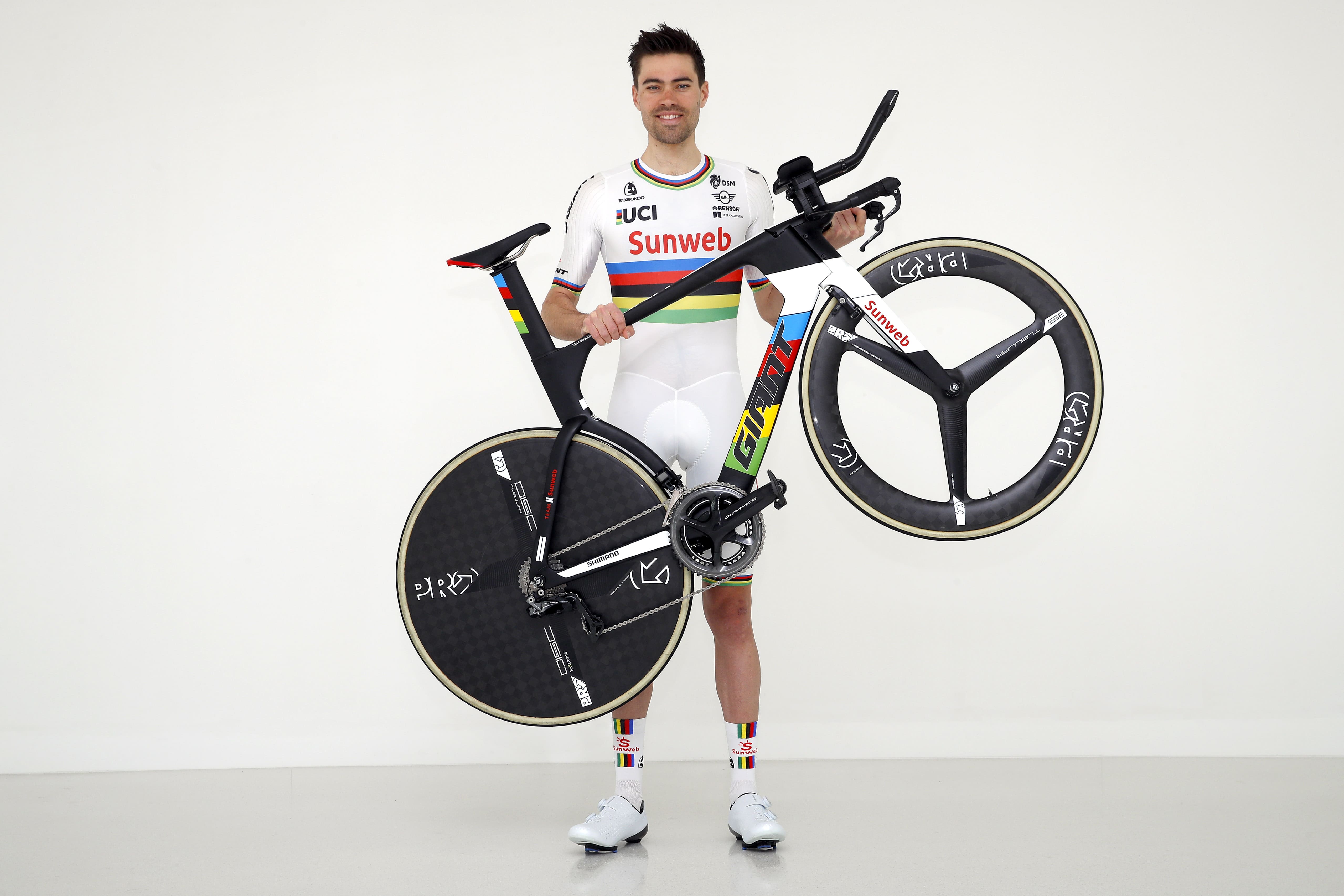
It was a second skin: the tightest, lightest and fastest suit Etxeondo had ever made. Months of work had gone into it, tailoring the fabric millimetre by millimetre to Dumoulin’s body. He had worn it in the wind tunnel to measure aerodynamic gains — ribbed stripes were added to the sleeves to reduce turbulence and improve airflow over his back. In June it had to be redesigned at the last minute after Sunweb signed a new sponsor for the Tour. It was then sent to Sierra Nevada, in Granada, where Dumoulin was training at altitude, ready for July 28.

He was the reigning world time trial champion. The penultimate stage — the only individual time trial of that Tour — was his final chance of a stage win, and potentially decisive for the podium in Paris. Dumoulin lay second overall, two minutes behind Geraint Thomas, but only 19 seconds ahead of Primož Roglič and 32 ahead of Chris Froome — both formidable against the clock.

Over forty minutes of flat-out effort, an aerodynamic skinsuit might gain a handful of seconds. That handful might change everything.

And Dumoulin couldn’t find it.

At 10:15 a.m., he messaged Patxi Rodrigo, Etxeondo’s manager: “Patxi, we have a problem. I’ve lost the bag with my TT suit. I start at four this afternoon but I can’t find it. Do you have another one at the factory? Could you get it to me in time?” Minutes later: “Sorry, Patxi, I know the team has already called you, but I need to race in that suit no matter what. If not, I’ll try to go fast in normal kit,” followed by a red-cheeked sweating emoji.

There was no spare. It would have to be made from scratch.

Dumoulin’s only consolation was geography. The stage ran through Lapurdi, in the French Basque Country, between Saint-Pée-sur-Nivelle and Espelette — just 65 kilometres from Etxeondo’s headquarters in Irura. But it was late July. The factory was closed. The staff were on holiday. Patxi and his sister Amaia, head of design and product development, had gone to Saint-Pée-sur-Nivelle with six or seven colleagues to watch the stage. They phoned their father, Paco Rodrigo, founder and general manager, who was at home preparing a leisurely Saturday breakfast while listening to Edith Piaf.

“It’s impossible,” Paco said. “But we’ll try.”

“LET SOMEONE FROM OUTSIDE LOOK AT US AND TELL US IF WE’RE REALLY THAT HANDSOME”

Etxeondo’s relationship with Dumoulin’s Dutch team began almost by accident.

In 2010, the company’s commercial director couldn’t attend Interbike in Las Vegas, the biggest trade fair in the Americas. Paco sent his children instead.

“We were just kids — especially me,” Patxi says. “I was 21 and didn’t even work at Etxeondo yet.” Amaia was 27. “The airline lost our luggage, we arrived at night, and had to go shopping in the early hours because we had an important lunch the next day. We were amazed — the shops were open all night, DJs playing, lights everywhere. Amaia loved it. I kept falling asleep in the corners of the shops.”

The following day, impeccably dressed, they lunched with Stan Mavis — former athlete, 1980 world half-marathon record holder, co-founder of Pearl Izumi’s US arm, and Etxeondo’s American distributor.

“An athlete and a gentleman,” Paco says. “We wanted to expand abroad and he helped us enormously.”

Mavis treated them to lunch at Picasso, one of Las Vegas’s most vaunted restaurants. Following his father’s instructions, Patxi discreetly paid with Etxeondo’s company card.

“I rang Paco afterwards, terrified: ‘We’ve been absolutely fleeced on this trip…’ But we built a strong relationship with Mavis. And that turned out to be important.”

Bonnie Mavis, Stan’s wife, worked with luxury fashion brands. When she looked closely at Etxeondo’s garments, she was struck by their detail.

“She knew what she was looking at — the threads, the stitching, the pattern construction, the direction of the fabrics, the colour work. She saw that this level of quality wasn’t common in sportswear.”

In September 2012, at the Eurobike trade fair in Germany, Etxeondo executives received an unexpected visit.

“Tom Davies, sponsorship manager at Giant — one of the world’s leading bike manufacturers — came up to us and said, just like that: ‘You’re going to make the kit for Team Rabobank next season,’” Paco recalls.

Giant supplied bikes to the Dutch Rabobank team. But Paco Rodrigo had heard nothing about Etxeondo supplying the team’s clothing.

“I was stunned. I said, ‘This is going to cost you a fortune…’ He replied, ‘Don’t worry. It doesn’t matter what it costs. It’s done.’ Giant had just appointed Stan Mavis as CEO, and he had convinced Rabobank that the best clothing was Etxeondo’s.”

The men’s Rabobank team was among the big hitters of the pro peloton, with riders such as Bauke Mollema, Steven Kruijswijk, Wilco Kelderman, Michael Matthews, Juanma Garate and Luis León Sánchez on their books. The Rabobank Liv Giant women’s team was the best in the world, with Marianne Vos, Annemiek van Vleuten, Pauline Ferrand-Prévot and Lucinda Brand.

By then, Etxeondo’s strategy for gaining visibility no longer focused solely on dressing the very best professional teams, as it had in the 1980s and 1990s. Racing was becoming just part of a much larger puzzle. More and more people saw the bike as a means of tourism, leisure, travel, health and wellbeing. Etxeondo was already working in those areas. But Rabobank opened other doors — to a much wider world.

Paco Rodrigo was convinced Etxeondo had to succeed abroad too. So he asked Paul Santen, a Dutch expert working for a global sportswear giant, to examine the company from top to bottom.

“He came to check everything: the machines, the materials, the processes, our production capacity… We wanted to confirm whether we truly had the quality we thought and the capacity to manufacture everything that would be asked of us. It was very useful. After many successful years at home, there’s always the risk you start believing you’re very handsome. It’s good to have someone from outside look at you and tell you whether you really are — or not quite.”

Countries with the strongest cycling traditions — France, Italy, Spain, Belgium, the Netherlands — each had their own dominant local brands, but few crossed borders. In the 21st century markets internationalised rapidly, and Etxeondo wanted a piece of the action. Sales grew in the Netherlands and Belgium; they also made ground in Germany and France; gradually they expanded into around thirty countries across three continents.

“Supplying Rabobank gave us an international stamp of prestige,” says Patxi. “We’re a Basque brand; until then we’d made kit for teams from our own part of the world. But we proved we had the quality to do well anywhere.”

In September 2012 they agreed Etxeondo would make Rabobank’s race clothing for the 2013 season. They designed and manufactured the kit… and in mid-October Rabobank announced it would stop sponsoring the men’s team, following the United States Anti-Doping Agency report on Lance Armstrong’s doping programme and the scandals of previous years. Rabobank would continue paying, as required by contract, until a replacement sponsor was found — but it did not want the team to bear its name or colours.

“We had the entire Rabobank kit ready… and suddenly we had to start all over again.”

They designed a jersey with black, white and blue vertical stripes and the same three colours around the cuffs. The space on the torso usually reserved for the main sponsor’s logo was occupied by a word, a name, reflecting Rabobank’s wishes to remain invisible: Blanco, literally “white” or “blank”. It was one of the most unusual jerseys in cycling sponsorship history.

“Not only that, but halfway through 2013 they found a new sponsor: Belkin, an American company that makes phone and electronic accessories,” Paco says. “There were only two weeks before the Tour and we had to design yet another kit in double quick time. They were very clean, very beautiful jerseys, with green, white and black horizontal stripes.”

Between Rabobank, Blanco, Belkin and the Rabobank Liv women’s team, Etxeondo produced four different kits in eight months.

THE RISE OF DUMOULIN

In 2013, executives from the Dutch team Argos-Shimano travelled to Ormaiztegi (Gipuzkoa) to purchase a team bus from Irizar. At Irizar they were told that just around the corner they could also find the best cycling clothing — at Etxeondo.

“They came to meet us, told us about their project, and we really liked it,” says Paco. “It was a mid-level WorldTour team with an ambitious growth plan and clear ideas. They were very innovative. We’ve always liked that kind of project — getting involved from the ground up and growing together, as we had with Reynolds, Orbea, Caja Rural, Clas, Once, Euskaltel… We recommended the project to Giant.”

And so Giant-Shimano was born in 2014, a Dutch team backed by the Gipuzkoan companies Irizar and Etxeondo. Its talisman was German sprinter Marcel Kittel, winner of three Tour stages in 2013. There were also promising youngsters like French climber Warren Barguil and German classics specialist John Degenkolb. And a 22-year-old Dutchman who was yet to score a pro win: Tom Dumoulin.

“They didn’t have the biggest budget, so they squeezed the maximum out of everything. They were extremely well prepared in every area — engineers, tacticians, meticulous coaches focused on bikes, nutrition, training… and they demanded a lot from Etxeondo with the clothing too. That was great for us. We developed very special technical pieces with them, like the Dyneema bib shorts.”

These were anti-crash shorts — as elastic and comfortable as any others, but incorporating an extremely resistant fibre that protected riders from cuts and abrasions. They won the award for best garment at Eurobike 2015 and, above all, were appreciated by the riders. Barguil crashed in the Tour de France and shredded the skin on his arms, but his thighs were untouched. Hence, in the next few stages, the cuts didn’t affect his performance.

“I loved that team,” Patxi continues, “because you could see how they paid attention to every detail and tried to outsmart the bigger teams. I remember how they set up the lead-outs for Kittel — that’s how he won so many Tour stages… Or the two stages and mountains jersey Barguil won in 2017… In the Classics there were much stronger, more established teams, but Degenkolb shows up and wins Milan-San Remo and Paris-Roubaix in the same season. Only Sean Kelly had ever done that before, in 1986 — and he was also wearing an Etxeondo jersey, with Kas.”

Of Mathieu van der Poel achieving the same double in 2025, Paco says with a rueful smile, “That ruined our exclusivity.” 

With this team — Giant-Alpecin and Sunweb-Giant in its later iterations, with what became the trademark black-and-white kit — Tom Dumoulin would eventually establish himself as the best Dutch Grand Tour rider of the 21st century. He was tall, powerful, outstanding in time trials and remarkably resilient in the mountains, well capable of limiting his losses to pure climbers in the high mountains. In 2015 he came close to winning the Vuelta a España, losing the lead on the penultimate stage; in 2016 he won the Giro prologue and two Tour stages; and in 2017 he won the Giro in unforgettable fashion, famously stopping during a decisive Alpine stage for a “nature break” in a field adjacent to the race route and losing sight of his rivals before chasing back over the fearsome Umbrailpass. He eventually conceded just two minutes and held on to the pink jersey by the narrowest margin. With his final overall victory in Milan, Etxeondo completed the triple crown of Vuelta, Giro and Tour wins.

Then came 2018, when Dumoulin set his sights on an improbable Giro-Tour double. In the Giro, only Chris Froome’s extraordinary long-range attack over the Colle delle Finestre to the Jafferau denied him a second victory in a row. He finished the race as runner-up, less than a minute adrift of Froome.

“In the half-century Etxeondo has been in cycling, Dumoulin has given me some of the highest highs and lowest lows,” says Paco. “He’s such a good person — friendly, always trying to be polite. He’s all heart. And he was a fabulous rider who could have built one of the greatest palmarès in history — that’s my great regret. If he’d had stronger domestiques, like the big teams did, he would have won the Vuelta in 2015, the second Giro in 2018, and maybe even the Tour that same year.”
ETXEONDO’S TEAM TIME TRIAL

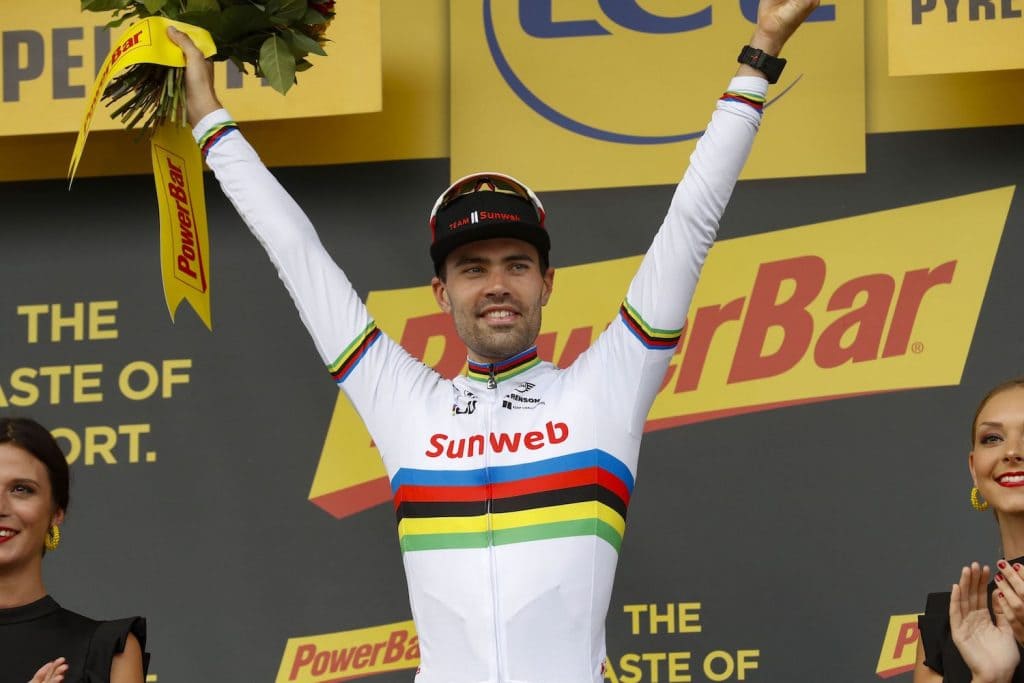
Alas, he would indeed fall agonisingly short in the 2018 Tour just as in the Giro  — Geraint Thomas beating him by just under two minutes. Thomas’s advantage ahead of the 31-kilometre time trial between Saint-Pée-sur-Nivelle and Espelette had looked unassailable, but Dumoulin still hoped to take a stage win and prevent Froome from stealing his second place. Then, at ten in the morning, he’d discovered that his skinsuit was missing. And so the first time trial of that day began — a team effort by Etxeondo’s skeleton staff — so that Dumoulin could win the second, the individual time trial contested by the stars of the Tour. 

Needless to say that Paco Rodrigo’s breakfast went cold. The company was officially on holiday, the factory closed, and so Paco Rodrigo immediately began firing off calls. María Jesús Altuna, the head of production, answered from the hairdresser’s and ran to Etxeondo to dig out Dumoulin’s measurements. Xabi Areizaga, the head of graphic design, had been asleep after a night out, but was soon reporting for duty to design the white suit with the five world champion stripes. A friend from Navarra drove Amparo Corcuera and Amparo Jiménez, seamstresses from Etxeondo’s Castejón workshop, 150 kilometres to Irura. Just in case, Paco also called Flori Hernández, a recently retired seamstress from the Irura headquarters.

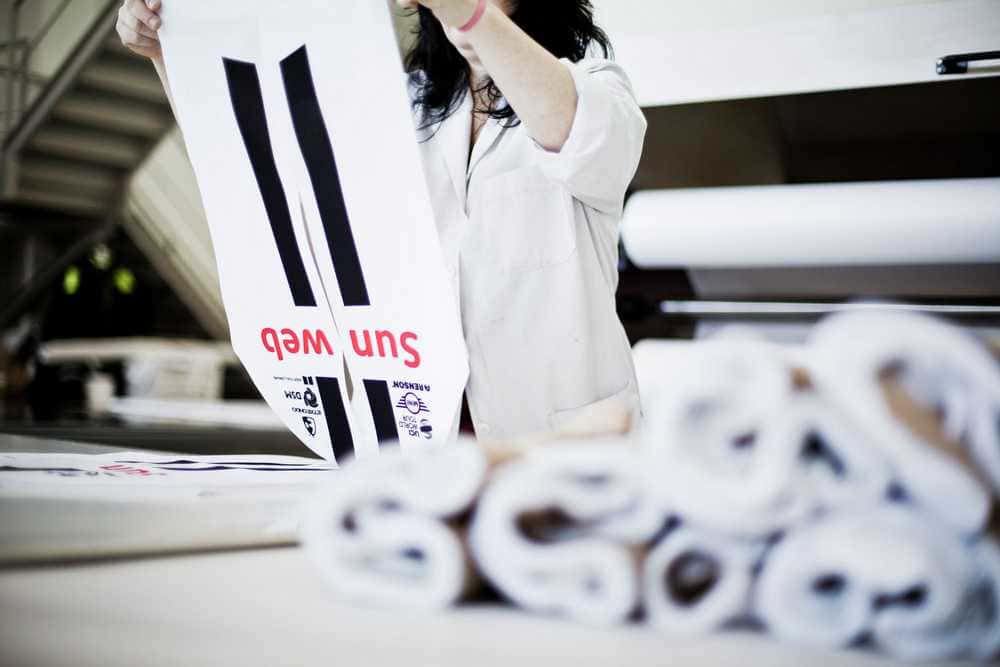
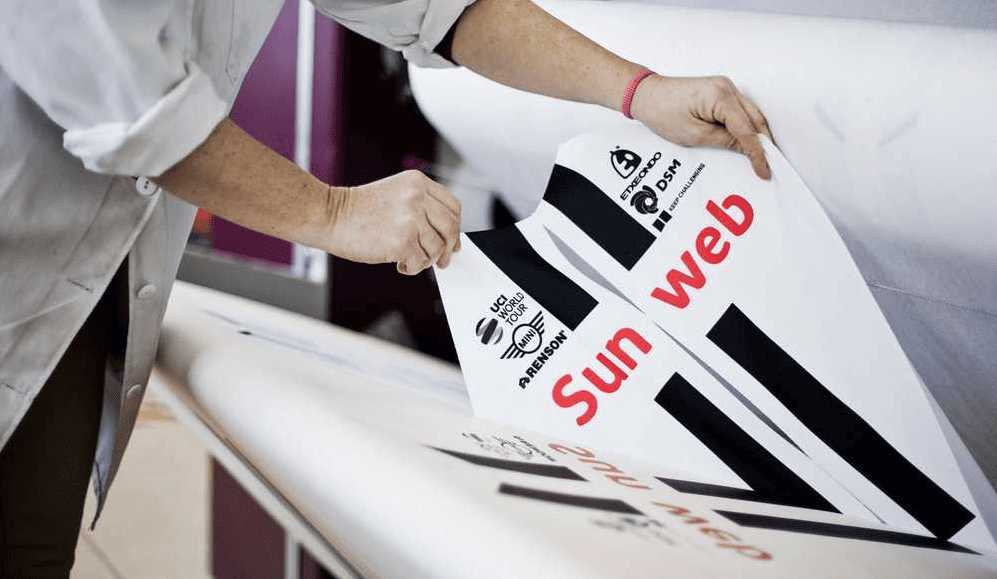
“Everything had to be done from scratch: draft the pattern, cut the fabrics, print them, sew each piece together, stitch in the chamois… A skinsuit is a very delicate garment — not just anyone can sew one properly — but we have fantastic seamstresses.”

Meanwhile, Patxi Rodrigo left Saint-Pée-sur-Nivelle in a Sunweb team car, with two French gendarmes on motorbikes escorting them. The team directors had explained the emergency to the Tour organisers and asked for help navigating the closed roads, traffic jams and crowds. Patxi arrived at Etxeondo shortly before noon and started sending Dumoulin regular updates via text messages that are still saved on his phone.

At 12:07 p.m., he sent a photo of the sleeve being sewn, with the message: “I hope we make it in time.”

At 12:30: “Tom, I’m on my way.

At 13:45: “I’ve got a gift for you.”

“I arrived at the Sunweb bus at two o’clock and handed the suit to Dumoulin personally,” Patxi recalls. “He got on the bus to try it on and called me inside to check the fit. He was happy, relieved. He hugged me and I wished him luck. When I came down, all the Etxeondo people who’d come to watch the stage were there and suddenly we were jumping up and down, hugging each other as though we’d already won the stage.”

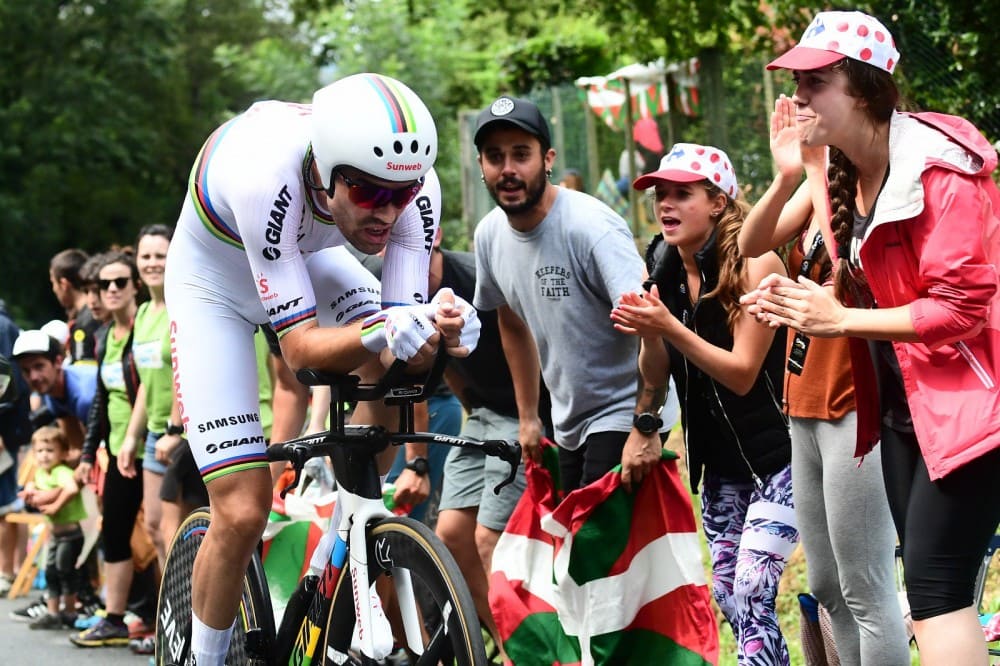
At 4:27 p.m., Tom Dumoulin rolled down the start ramp in his dazzling, freshly sewn world champion skinsuit. The course meandered through the green hills between Saint-Pée-sur-Nivelle and Espelette, a sinuous maze of narrow, undulating roads. At intermediate checkpoints, the gaps were tiny. Thomas then eased up on the final descent and fell out of contention. Froome had set the fastest time. And Dumoulin finished… one second short.

Despite Etxeondo’s frantic efforts, despite squeezing every last watt from his body, Dumoulin had lost the stage by hundredths of a second.

Then one of the timekeepers noticed something odd: the clock had stopped early on Froome’s ride, a few metres before the line. They recalculated. The stage winner was Tom Dumoulin — by one second.

“We couldn’t believe it,” says Paco.

“We started jumping and hugging again,” Patxi recalls.

Dumoulin had ridden for 41 minutes at an average speed of 45.5 kilometres per hour. There was no doubt: the suit made from scratch that very morning had been the difference between victory and defeat.

Interviewed on television just before stepping onto the podium, Dumoulin had no doubt: “This morning I couldn’t find my time trial suit and I want to thank my friends at Etxeondo because they made me a new one just in time. We were lucky the stage was in their home, here in the Basque Country — otherwise we would have had a serious problem. I’m very happy to dedicate this victory to them.”

Patxi Rodrigo still gets emotional, from the vantage point of several years later. 

“At the time I burst into tears. You spend years working day after day to build a brand that is your family, your company, your people. You try to innovate, to make the best possible product, to prove your quality abroad. You experiment, you fail here and there, you suffer setbacks… and then something extraordinary like that happens, with Dumoulin’s suit, your work has such a decisive impact on one of your favourite riders winning a Tour stage, and he thanks you on television… I just cried.”

Dumoulin’s comments piqued the curiosity of journalists following the Tour on the ground and from all over the world. Over the next few days Patxi Rodrigo was interviewed by major cycling media outlets from across Europe, the United States, Korea and Japan. Etxeondo had never received so much media attention — and it happened precisely when they were working hard to internationalise the brand.

“After that,” Patxi says, “at international trade fairs we’d introduce ourselves as Etxeondo and people would say: ‘Ah yes — you’re the ones with Dumoulin’s skinsuit!’”

¿TE HA GUSTADO?

Suscríbete para no perderte ninguno de nuestros artículos aquí

TAMBIÉN TE PUEDE INTERESAR

Guía de cómo vestir este Otoño-Invierno 24/25 HZ KLASIKOA: Een dag om te herinneren

Een fietsweekend in het teken van gedeelde passie in eigen streek

Lees verder
Guía de cómo vestir este Otoño-Invierno 24/25 “Duursporten geven ons de mentale kracht die we ook nodig hebben om te vliegen”

Savina Paül en Pol Arisó zijn de hoofdrolspelers in de volgende reportage en afbeelding van de Essentials-collectie SS25. We stellen ze aan je voor! 

Lees verder
Guía de cómo vestir este Otoño-Invierno 24/25 "Fietsen is een constante uitdaging"

Ana Mafalda Santos, de onthulling van vrouwenwielrennen in Portugal

Lees verder
VOLVER A LA MAGAZINE
Toegevoegd aan de comparator
Er kunnen geen producten meer worden vergeleken.