Anmelden

The ‘90s (1989-1997): “You can design the most beautiful jersey in the world, but if you never see the riders, it’s not much use.”

by Ander Izagirre 

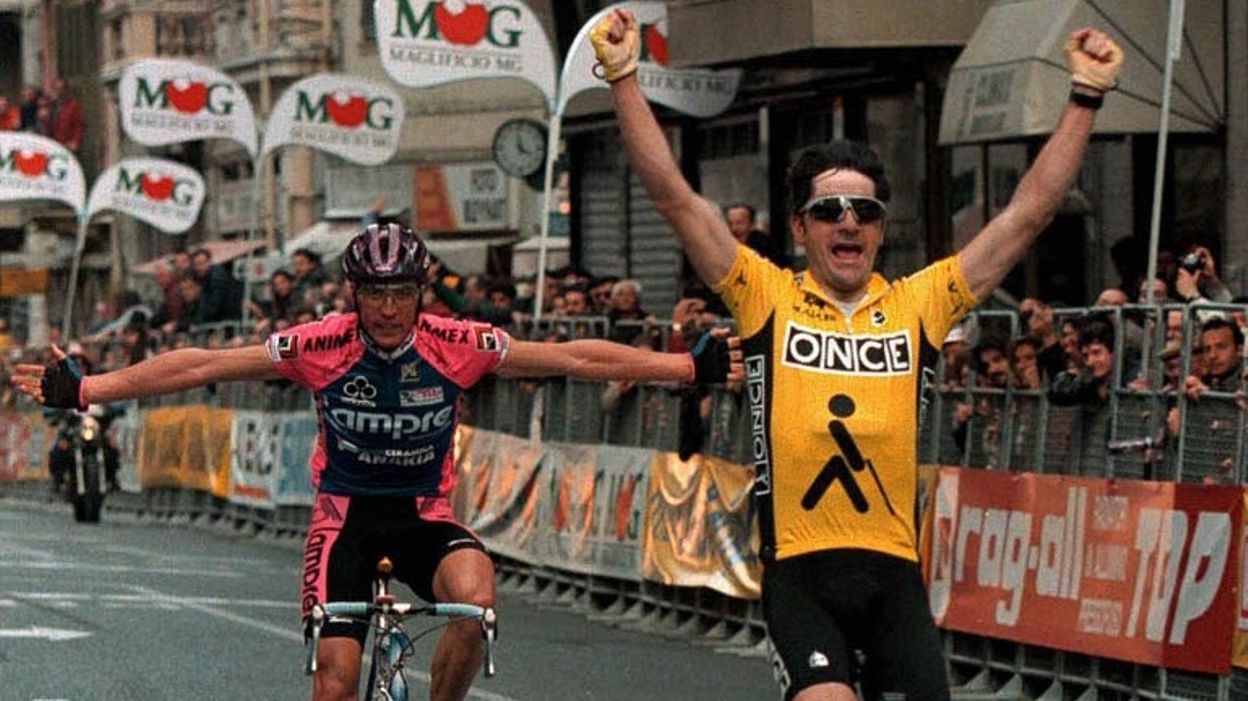
The ONCE jersey was one of the iconic kits of the 1990s peloton. The Spanish National Organization for the Blind (ONCE) was a behemoth, with its own strict brand guidelines and a clearly defined corporate identity — a rarity at the time. Reconciling this with Etxeondo’s vision for how the team should look on the road, however, wasn’t always straightforward. 

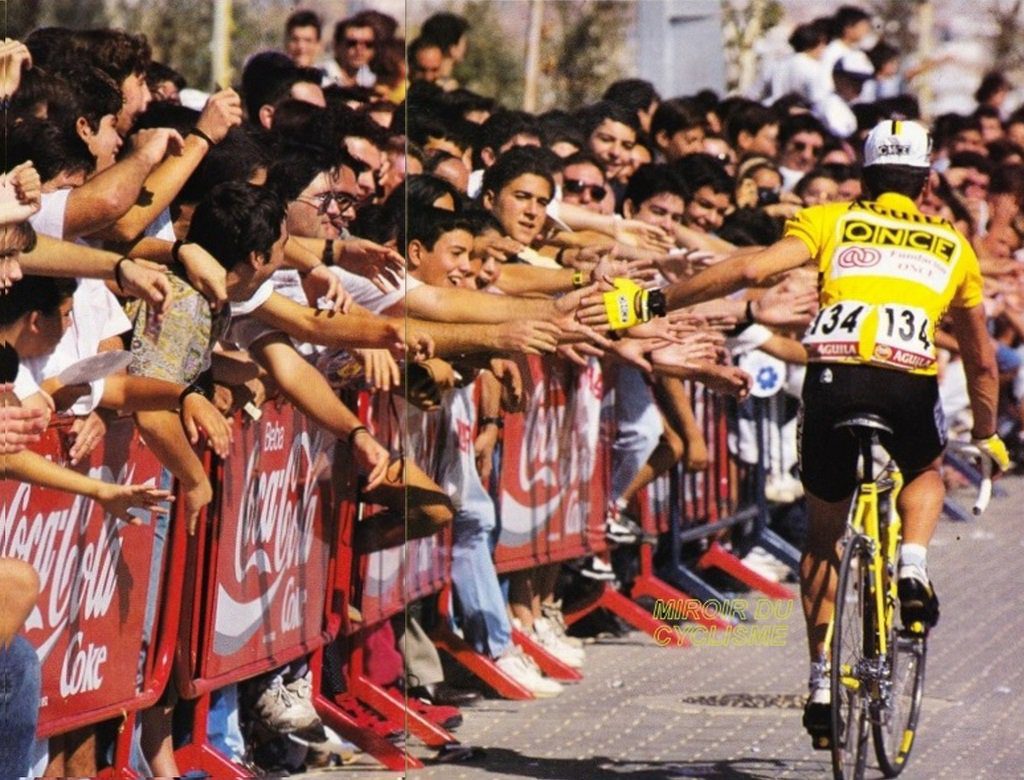
“I used to watch a lot of television, to see how jerseys looked in the peloton — at speed, in different light… ONCE’s brand colours were green and yellow, but that didn’t show up well on TV; we needed something sharper,” Paco Rodrigo says. “I designed a jersey in a very clean, bright yellow, with white lettering on black panels that stood out beautifully… And then Manolo Saiz did a great job of selling the idea to the sponsor.”

“I sold it because María Jesús and Paco had explained everything to me,” Saiz picks up. “With them I learned a thousand things about colours, fabrics, elasticity, cuts — all the technical side of clothing. I explained to the ONCE bosses that a yellow jersey would be much more visible; that white and black were positive and negative, that they created contrast; that on the side panels we would keep the five boxes with the four letters of ONCE and the blind person pictogram, as required by their branding guidelines, but that on the chest it would look cleaner to use just the four lettered boxes and put the large pictogram underneath…”

“The important thing is not to overload the jersey, clutter it up with letters and logos. Less is more,” says Paco.

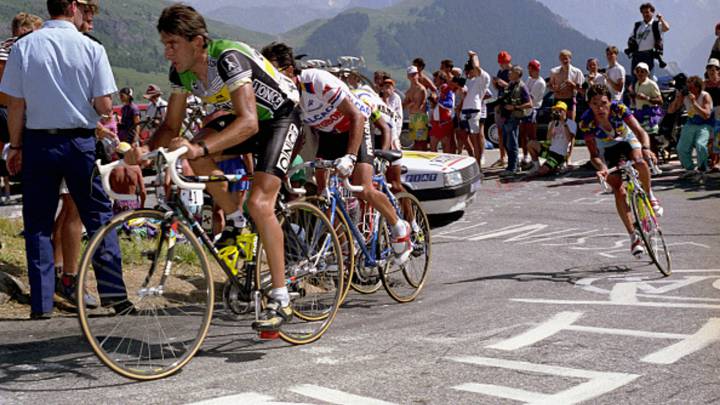
The Tour does not allow teams to ride in predominantly yellow kit, to avoid confusion with the leader’s jersey, hence Etxeondo had to come up with another design for ONCE, as they had previously done with Kas.

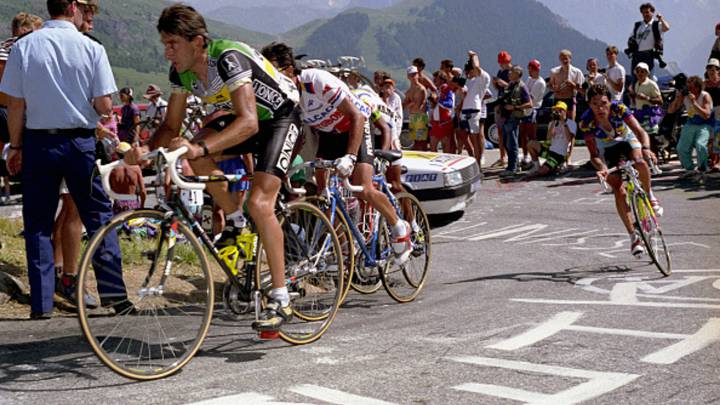
“For the 1990 and 1991 Tours we made that jersey with diagonal green, grey and yellow stripes, and black side panels,” Paco recalls. “We lost a bit of identity, but it looked very beautiful.”

“That jersey was a hit in Japan — it sold very well there. It has a slightly oriental feel, doesn’t it? Those diagonal rays…”

The team looked slick and rode fast, too: Chozas and Lejarreta won consecutive stages and finished sixth and fifth overall.

“That’s fundamental to a jersey’s success: that the riders win,” says Paco Rodrigo. “Because you can design the most beautiful jersey in the world, but if you never see the riders, it’s not much use.”

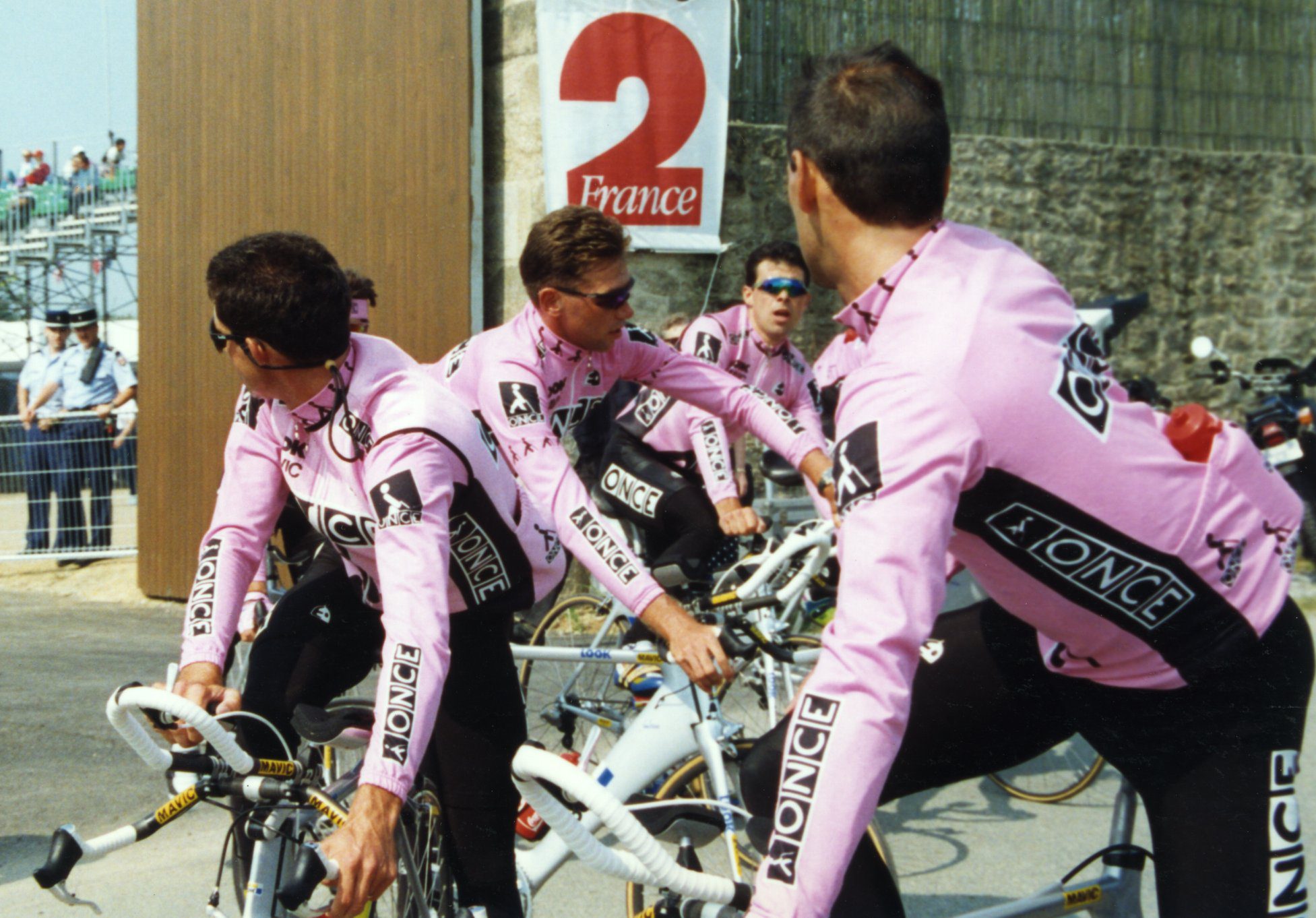
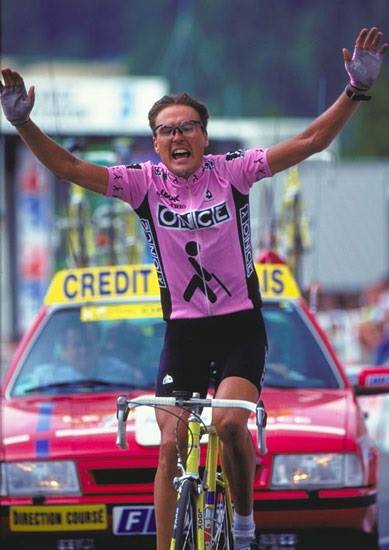
In the Tours that followed, ONCE opted for a design identical to their usual kit but with pale pink replacing yellow.

“It was a beautiful pink,” says Saiz.

With the colour change also came a generational shift in leadership for the Tour: from Marino Lejarreta and Eduardo Chozas to Alex Zülle and Laurent Jalabert.

“If we’d had Lejarreta at twenty…” says Saiz. “Marino was an adventurer; he loved experimenting, innovating. We understood each other well — we could have mapped out his whole career. But we had him in his final years and it was a privilege. He rode a very good Tour; he came close to winning a Giro…”

With Jalabert, by contrast, they were able to plan and go on a surprising journey — from sprinter to Grand Tour contender.

“Jalabert was a fast rider. He’d finish third in one sprint, fifth in another, fourth in another — every now and then he’d win a race… But I saw much greater potential and we began to work on it. I set him goals: first I trained him to handle medium mountains better, so he could win from small groups when the pure sprinters had been dropped. Then I convinced him to take time trials seriously; I saw he could do well in them and that they would give him a chance to win week-long stage races. It was a gradual transformation, until the crash in Armentières.”

In the first stage of the 1994 Tour, a gendarme stepped into the road to take a photograph of the peloton sprinting towards the finish line. The Belgian Nelissen collided with him, triggering a cascade of crashes behind. Jalabert was left dazed on the ground, bloodied, toothless and with his jaw shattered.

“Yes, Laurent really listened to me and he was very much on board. I talked constantly with the riders. One of the advantages I had was that I became a directeur sportif but maintained that fraternal relationship with the riders — I’d lie on the bed with them and we’d talk about everything. We were very close, there was remarkable trust.”

Saiz hadn’t decided to reinvent Jalabert on a whim: he had already won seven stages at the 1994 Vuelta a España, six of them in sprints and one on the summit of Lagos de Covadonga. In 1995 he produced on a tour de force on the savage stage to Mende and finished fourth in the Tour, with his teammate Zülle second behind Induráin. A few weeks later, Jalabert triumphed in the Vuelta a España with another five stage wins, and teammates Bruyneel and Mauri in third and fourth overall. ONCE were experiencing a golden age.

The partnership with Etxeondo ended in 1997, when ONCE’s executives signed an agreement with one of the world’s largest sportswear brands. Manolo Saiz and Paco Rodrigo worked together again in 2006, with the Liberty-Würth team wearing Etxeondo, until Operación Puerto led to the team’s implosion midway through the season.

“Paco won’t say it, but when we changed suppliers some riders would still go to him to have their kit made, even though they later put another brand’s logo on it,” says Saiz. “Etxeondo has always made the best bib shorts in the world, by far. And they’ve always taken extraordinary care with details: the cut of the garments was absolutely precise — not a centimetre too much or too little. Not a single wrinkle on the shoulders or around the stomach. When you spend six hours on a bike, that comfort makes a difference… Never mind when you’ve been in the saddle for fifty.”

¿TE HA GUSTADO?

Suscríbete para no perderte ninguno de nuestros artículos aquí
TAMBIÉN TE PUEDE INTERESAR

Guía de cómo vestir este Otoño-Invierno 24/25 ROOTS AT HOME, BRANCHES OPEN TO THE WORLD

While expanding internationally, Etxeondo also took care to maintain and nourish its deep roots in its home region, supporting the growth of teams such as Kern Pharma and the new Euskaltel-Euskadi. In 2026 the company celebrates its fiftieth anniversary while ushering in a new phase in the company’s history and renewing its commitment to sustainable growth, a strong historical identity and the enduring quality of its cycling kit.  
Mehr
Guía de cómo vestir este Otoño-Invierno 24/25 The Evolution of Excellence: Etxeondo’s New Spring/Summer Collection

Every new Etxeondo collection is the result of a meticulous process, where tradition and innovation converge in perfect harmony.

Mehr
Guía de cómo vestir este Otoño-Invierno 24/25 Alde Metalic, Design und Leistung vereint in einem Trikot.

Jede Linie, jede Kurve, fügt sich nahtlos in die städtische Landschaft ein und wird zu einem integralen Bestandteil der Umgebung, die durch Technologie und Design neu definiert wurde.

Mehr
VOLVER A LA MAGAZINE

Comments (0)

No comments at this moment
Zum Vergleich hinzugefügt
Es können keine weiteren Produkte verglichen werden.